|
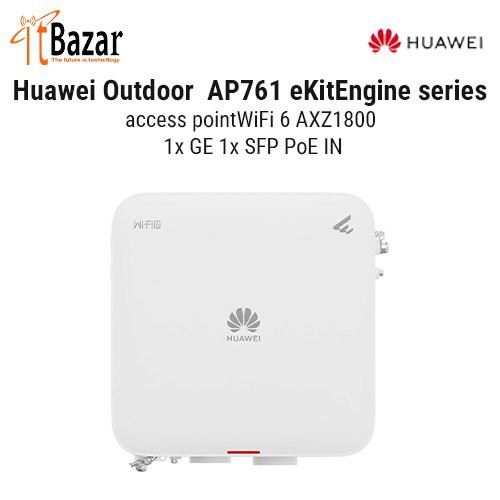
Huawei AP761
|
|
Technical specifications
|
|
Dimensions (H x W x D)
|
69 x 200 x 200 mm
|
|
Weight
|
1,91 kg
|
|
Ports
|
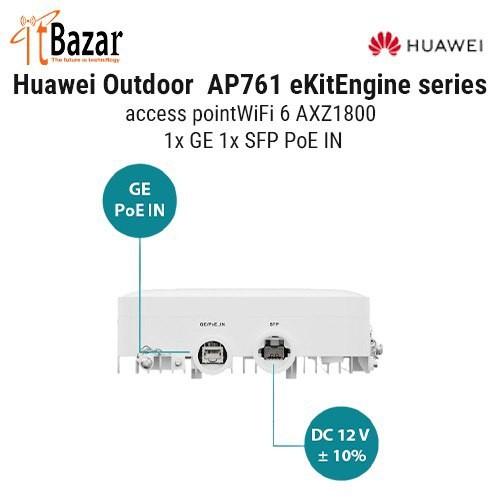
1 x 10M/100M/GE electrical port
1 x SFP optical port(The GE electrical port supports PoE-In)
|
|
Bluetooth
|
BLE 5.2
|
|
LED indicator
|
Indicate the power-on, startup, running, alarm, and fault
states
of the system
|
|
Power supply specifications
|
|
Power input
|
PoE power supply: in compliance with IEEE 802.3at/af
(When working in 802.3af power
supply mode, the AP is restricted in
functions)
|
|
Maximum power consumption
|
17,7 W
|
|
Environmental specifications
|
|
Operating temperature
|
–40°C to +65°C
|
|
Storage temperature
|
–40°C to +85°C
|
|
Operating humidity
|
0%-100%
|
|
IP rating
|
IP68
|
|
Radio specifications
|
|
Antenna type
|
Built-in directional antennas
The horizontal and vertical
beamwidths of 2.4 GHz antennas are 65° and
40°, respectively.
The horizontal and vertical beamwidths of 5 GHz antennas are 65° and
20°, respectively.
|
|
Antenna gain
|
2,4 GHz: 10 dBi
5 GHz: 11 dBi
BLE: 5 dBi
|
|
Maximum quantity of SSIDs
on each radio
|
≤ 16
|
|
Maximum number of STAs
|
≤ 1024 (512/radio)
|
|
Maximum transmit power
|
2,4 GHz: 28 dBm
5 GHz: 27 dBm
|
|
Power adjustment increment
|
1 dBm
|
|
Maximum number of nonoverlapping channels
|
2.4 GHz (2.412 GHz – 2.472 GHz)
802.11 b/g
802.11 n
802.11 ax
5 GHz (5.18 GHz – 5.825 GHz)
802.11 a
802.11 n
802.11 ac
- 20 MHz: 13
- 40 MHz: 6
- 80 MHz: 3
- 160 MHz: 1
802.11 ax
- 20 MHz: 13
- 40 MHz: 6
- 80 MHz: 3
- 160 MHz: 1
|
|
Fat/Fit AP mode
|
|
WLAN features
|
Compliance with IEEE 802.11ax and compatibility with IEEE
802.11a/b/g/n/ac/ac Wave 2
Maximum ratio combining (MRC)
Space time block code (STBC)
Cyclic delay diversity (CDD)/Cyclic shift diversity (CSD)
Beamforming
Multi-user multiple-input multiple-output (MU-MIMO)
Orthogonal frequency division multiple access (OFDMA)
Compliance with 1024-QAM and compatibility with 256-QAM/64-QAM/16-QAM/8-QAM/QPSK/BPSK
Target wake time (TWT)
Low-density parity-check (LDPC)
Frame aggregation, including A-MPDU (Tx/Rx) and A-MSDU (Tx/Rx)
802.11 dynamic frequency selection (DFS)
Short GI in 20 MHz, 40 MHz, and 80 MHz modes
Priority mapping and scheduling that are compliant with Wi-Fi multimedia
(WMM) to implement priority-based data processing and forwarding; automatic
and manual rate adjustment (the rate is adjusted automatically by default)
WLAN channel management and channel rate adjustment
Automatic channel scanning and interference avoidance
Separate service set identifier (SSID) hiding configuration for each AP,
supporting Chinese SSIDs
Signal sustain technology (SST)
Unscheduled automatic power save delivery (U-APSD)
Control and provisioning of wireless access points (CAPWAP) in Fit AP mode
Extended service set (ESS) in Fit AP mode
Advanced cellular coexistence (ACC), minimizing the impact of interference
from cellular networks
Multi-user CAC
802.11k and 802.11v smart roaming
802.11r fast roaming (≤ 50 ms)
|
|
Network features
|
Compliance with IEEE 802.3ab
Auto-negotiation of the rate and duplex mode and automatic switchover between
the Media Dependent Interface (MDI) and Media Dependent Interface Crossover
(MDI-X)
Compliance with IEEE 802.1Q
VLAN assignment by SSID
VLAN trunk on uplink Ethernet ports
Management channel of the AP’s uplink port in tagged or untagged mode
DHCP client, obtaining IP addresses through DHCP
Application identification and QoS classification on the AP in local
forwarding (direct forwarding) mode for better voice quality (identifiable
common applications in the industry: Skype, QQ, and WeChat)
STA isolation in the same VLAN
IPv4/IPv6 access control list (ACL)
Link layer discovery protocol (LLDP)
Uninterrupted service forwarding upon CAPWAP tunnel disconnection in Fit AP
mode
Unified authentication on the WAC in Fit AP mode
WAC dual-link backup in Fit AP mode
Network address translation (NAT) in Fat AP mode
IPv6 in Fit AP mode
Telemetry in Fit AP mode, quickly collecting AP status and application
experience parameters
Soft generic routing encapsulation (GRE)
IPv6 source address validation improvements (SAVI)
Multicast Domain Name Service (mDNS) gateway protocol
|
|
QoS features
|
Priority mapping and scheduling that are compliant with
Wi-Fi multimedia (WMM) to implement priority-based data processing and
forwarding
WMM parameter management for each radio
WMM power saving
Priority mapping for uplink packets; flow-based mapping for downlink packets
Queue mapping and scheduling
User-based bandwidth limiting
Adaptive bandwidth management (automatic bandwidth adjustment based on the
user quantity and radio environment) for user experience improvement
Airtime scheduling
Air interface HQoS scheduling
Intelligent multimedia scheduling algorithm
|
|
Security features
|
Open system authentication
WEP authentication/encryption using a 64-bit, 128-bit, 152-bit, or 192-bit
encryption key
WPA2-PSK authentication and encryption (WPA2-Personal)
WPA2-802.1X authentication and encryption (WPA2-Enterprise)
WPA3-SAE authentication and encryption (WPA3-Personal)
WPA3-802.1X authentication and encryption (WPA3-Personal)
WPA-WPA2 hybrid authentication
WPA2-WPA3 hybrid authentication
WPA2-PPSK authentication and encryption in Fit AP mode
WAPI authentication and encryption
WIDS/WIPS, including rogue device detection and containment, attack detection
and dynamic blacklist, and STA/AP blacklist and whitelist
802.1X authentication, MAC address authentication, Portal authentication,
etc.
DHCP snooping
Dynamic ARP inspection (DAI)
IP Source Guard (IPSG)
802.11w Protected Management Frames (PMF)
IPsec/DTLS encryption
|
|
Maintenance features
|
Unified management and maintenance on the WAC in Fit AP
mode
Automatic login, automatic configuration loading, and plug-and-play (PnP) in
Fit AP mode
Automatic batch upgrade in Fit AP mode
Telnet
STelnet using SSHv2
SFTP using SSHv2
Remote wireless O&M through Bluetooth console ports
Web system-based AP management and login through HTTP or HTTPS in Fat AP mode
Real-time configuration monitoring and fast fault locating using the NMS
SNMPv1/v2/v3 in Fat AP mode
System status alarm
Network Time Protocol (NTP) in Fat AP mode
|
|
BYOD
|
Device type identification according to the
organizationally unique identifier (OUI) in the MAC address
Device type identification based on the user agent (UA) information in an
HTTP packet
Device type identification based on DHCP options
The RADIUS server delivers packet forwarding, security, and QoS policies
according to the device type carried in the RADIUS authentication and
accounting packets.(The AP supports BYOD only in Fit AP mode)
|
|
Spectrum analysis
|
Identification of multiple interference sources including
Bluetooth devices, microwave ovens, cordless phones, ZigBee devices, game
controllers, 2.4 GHz/5 GHz wireless video and audio devices, and baby
monitors
Working with a location server to locate interference sources and perform
spectrum analysis on them(The AP supports spectrum analysis only in Fit AP
mode)
|
|
Cloud mode
|
|
WLAN features
|
Compliance with IEEE 802.11a/b/g/n/ac/ac Wave 2/ax
Maximum ratio combining (MRC)
Space time block code (STBC)
Cyclic delay diversity (CDD)/Cyclic shift diversity (CSD)
Beamforming
Multi-user multiple-input multiple-output (MU-MIMO)
Orthogonal frequency division multiple access (OFDMA)
Compliance with 1024-QAM and compatibility with
256-QAM/64-QAM/16-QAM/8-QAM/QPSK/BPSK
Target wake time (TWT)
Low-density parity-check (LDPC)
Frame aggregation, including A-MPDU (Tx/Rx) and A-MSDU (Tx/Rx)
802.11 dynamic frequency selection (DFS)
Short GI in 20 MHz, 40 MHz, and 80 MHz modes
Priority mapping and scheduling that are compliant with Wi-Fi multimedia
(WMM) to implement priority-based data processing and forwarding
WLAN channel management and channel rate adjustment
Automatic channel scanning and interference avoidance
Separate service set identifier (SSID) hiding configuration for each AP
Signal sustain technology (SST)
Unscheduled automatic power save delivery (U-APSD)
|
|
Network features
|
Compliance with IEEE 802.3ab
Auto-negotiation of the rate and duplex mode and automatic switchover between
the Media Dependent Interface (MDI) and Media Dependent Interface Crossover
(MDI-X)
Compliance with IEEE 802.1Q
VLAN assignment by SSID
DHCP client, obtaining IP addresses through DHCP
STA isolation in the same VLAN
Access control list (ACL)
Unified authentication on the cloud management platform
NAT
Telemetry in Fit AP mode, quickly collecting AP status and application
experience parameters
|
|
QoS features
|
Priority mapping and scheduling that are compliant with
Wi-Fi multimedia (WMM) to implement priority-based data processing and
forwarding
WMM parameter management for each radio
WMM power saving
Priority mapping for uplink packets; flow-based mapping for downlink packets
Queue mapping and scheduling
User-based bandwidth limiting
Airtime scheduling
Air interface HQoS scheduling
|
|
Security features
|
Open system authentication
WEP authentication/encryption using a 64-bit, 128-bit, 152-bit or 192-bit
encryption key
WPA2-PSK authentication and encryption (WPA2-Personal)
WPA2-802.1X authentication and encryption (WPA2-Enterprise)
WPA3-SAE authentication and encryption (WPA3-Personal)
WPA3-802.1X authentication and encryption (WPA3-Enterprise)
WPA-WPA2 hybrid authentication
WPA2-WPA3 hybrid authentication
802.1X authentication, MAC address authentication, Portal authentication,
etc.
DHCP snooping
Dynamic ARP inspection (DAI)
IP Source Guard (IPSG)
|
|
Maintenance features
|
Unified management and maintenance on the cloud management
platform
Automatic login, automatic configuration loading, and plug-and-play (PnP)
Batch upgrade
Telnet
STelnet using SSHv2
SFTP using SSHv2
Remote wireless O&M through Bluetooth console ports
Web-based NMS, and login through HTTP or HTTPS
Real-time configuration monitoring and fast fault locating using the NMS
System status alarm
NTP
|