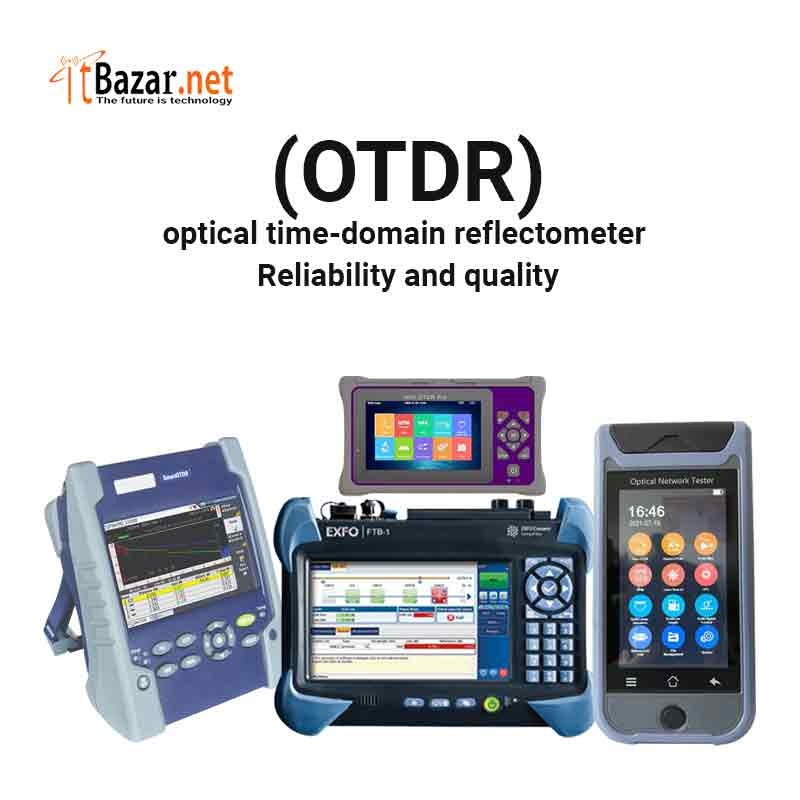
(OTDR) Optical Time-Domain Reflectometer

(0 reviews)
Brand
China

Inhouse product


Price Negotiable
Share

(OTDR) Optical Time-Domain Reflectometer 

 Optical Time-Domain Reflectometer (OTDR) is a specialized instrument used in the field of fiber optics to characterize and troubleshoot optical fibers. It works by sending a series of optical pulses into the fiber and measuring the light that is scattered or reflected back from points along the fiber. The OTDR can provide a detailed view of the fiber's length, including the location and magnitude of losses and faults.

Here's a basic overview of how an OTDR works and its key features:

How an OTDR Works

  1. Pulse Generation: The OTDR generates a series of optical pulses and sends them into the fiber under test.
  2. Backscatter and Reflections: As the pulses travel down the fiber, some of the light is scattered back due to Rayleigh scattering, and some is reflected back from discontinuities or faults such as connectors, splices, and breaks.
  3. Detection: The OTDR detects the backscattered and reflected light. The time it takes for the light to return is measured, which allows the OTDR to calculate the distance to the event causing the backscatter or reflection.
  4. Trace Display: The OTDR plots the backscattered signal as a function of time (and hence distance), producing a trace that shows the fiber's characteristics, including loss events and reflections.

Key Features of an OTDR

  • Distance Measurement: OTDRs can measure the length of the fiber and the location of faults or events with high accuracy.
  • Loss Measurement: They can measure the loss in the fiber, including attenuation per kilometer and loss at splices and connectors.
  • Event Identification: OTDRs can identify and locate events such as splices, connectors, breaks, and bends.
  • Dynamic Range: This refers to the maximum loss the OTDR can measure, which affects the maximum length of fiber it can test.
  • Dead Zones: These are regions near the OTDR where the high intensity of the initial pulse obscures the detection of backscatter. There are two types:
    • Event Dead Zone: The minimum distance after a reflective event where the OTDR can detect another event.
    • Attenuation Dead Zone: The minimum distance after a reflective event where the OTDR can accurately measure attenuation.


Reviews & Ratings

0 out of 5.0
(0 reviews)
There have been no reviews for this product yet.

Product Queries (0)

Login Or Registerto submit your questions to seller

Other Questions

No none asked to seller yet

Frequently Brought Products

itBazar

itBazar || Total Networking Solutions

WhatsApp
Messenger